
If you searched for iptv buffering, you are probably past the curiosity stage. You want enough information to make a buying decision without wasting time on inflated claims, outdated screenshots, or advice written for a different device.
This guide is written for US readers and uses a commercial-but-cautious approach. It explains what can be verified, what can change, which technical factors affect the experience, and how to move from research to the right plan without overbuying.
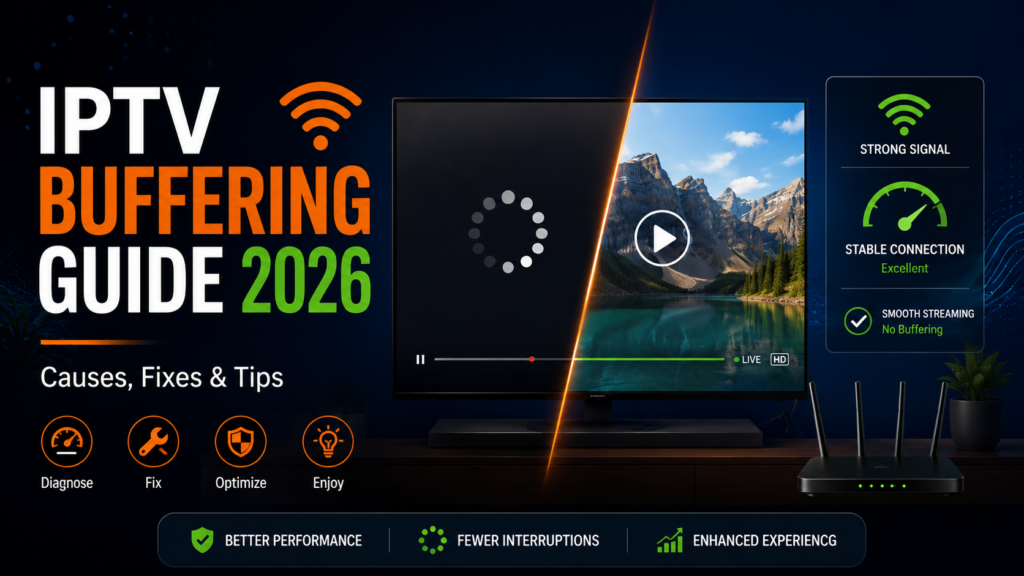
Quick answer: IPTV buffering happens when the player cannot keep enough video data ready for continuous playback. The cause can be the home network, ISP path, device, player, source, or service. Diagnose in that order instead of immediately changing providers or assuming one “speed” number guarantees perfect streaming.
Table of Contents
Table of Contents
What Buffering Actually Means
A streaming player keeps a small amount of upcoming video data in memory. If playback consumes that data faster than new data arrives, the buffer runs low and the player pauses while it waits for more. Researchers describe this as a buffer-underrun problem and study how changing network throughput affects playback quality.
That definition matters because buffering is a symptom, not a diagnosis. The missing data can be caused by a weak Wi-Fi link, ISP congestion, an overloaded device, a player problem, a network route, or the source itself.
Troubleshooting should therefore move from local and easy-to-test causes toward remote causes. Randomly changing several settings at once makes it harder to learn what actually fixed the problem.
Iptv Buffering: practical takeaway
The practical takeaway is to verify this point against your own device, household, and current site information before checkout. That keeps the keyword relevant without forcing it into every sentence and gives the reader a concrete next action.
Test the Connection at the Streaming Device
Run a network test near the television or on the streaming device if the platform supports it. A speed test beside the router can hide a weak signal in another room. Look for consistency across several tests rather than celebrating one unusually high result.
Also consider what else is using the connection. Cloud backups, game downloads, video calls, and several simultaneous streams can compete for capacity. If buffering appears only when the household is busy, local bandwidth competition is a plausible cause.
The goal is not to chase a magic Mbps number. It is to confirm that the connection can sustain the chosen stream quality with headroom.
Iptv Buffering: practical takeaway
The practical takeaway is to verify this point against your own device, household, and current site information before checkout. That keeps the keyword relevant without forcing it into every sentence and gives the reader a concrete next action.
Wi-Fi Signal, Interference, and Router Placement
Wi-Fi is convenient but sensitive to distance, walls, interference, and crowded radio channels. A streaming device hidden behind a television can receive a weaker signal than a phone held in the open.
Move the router or device temporarily to test whether distance matters. If practical, compare a wired Ethernet connection. A wired test is valuable because it separates wireless problems from broader internet or service problems.
Do not buy a new subscription to solve a Wi-Fi dead zone. Fix the local network first, then retest the stream.
Iptv Buffering: practical takeaway
The practical takeaway is to verify this point against your own device, household, and current site information before checkout. That keeps the keyword relevant without forcing it into every sentence and gives the reader a concrete next action.
Peak-Hour Congestion and Why Nighttime Can Be Worse
If playback is smooth in the morning but struggles in the evening, congestion becomes a useful hypothesis. More households are online after work and school, and ISP or upstream paths can be busier. This can reduce effective throughput or increase delay even if your plan advertises a high maximum speed.
Track the pattern for several days. Test the same device and same stream at different times. If the problem follows a consistent time window, that evidence is more useful than a single complaint.
Contact the ISP if ordinary streaming and speed tests also degrade significantly at the same times.
Iptv Buffering: practical takeaway
The practical takeaway is to verify this point against your own device, household, and current site information before checkout. That keeps the keyword relevant without forcing it into every sentence and gives the reader a concrete next action.
Restart the Player, Device, and Router—But Do It Methodically
A restart can clear temporary memory problems, stuck network sessions, and app state. Restart the player or device first. If the issue remains, restart the router and wait for the connection to fully return.
Do not repeatedly factory-reset hardware as a first step. A factory reset removes settings and creates extra work without proving the root cause. Use it only when normal troubleshooting and device-specific support justify it.
After each change, test long enough to know whether the symptom actually improved.
Iptv Buffering: practical takeaway
The practical takeaway is to verify this point against your own device, household, and current site information before checkout. That keeps the keyword relevant without forcing it into every sentence and gives the reader a concrete next action.
Check Device Storage, Memory, and Heat
Streaming devices can slow down when storage is nearly full, many apps run in the background, or the hardware becomes hot. Menu lag before playback begins is a clue that the device itself may be struggling.
Remove unused apps, clear temporary cache where the platform supports it, restart the device, and install normal system updates. An older device may also have difficulty decoding demanding streams that a newer box handles easily.
If a lighter player works better on the same account, the subscription may not be the main problem.
Iptv Buffering: practical takeaway
The practical takeaway is to verify this point against your own device, household, and current site information before checkout. That keeps the keyword relevant without forcing it into every sentence and gives the reader a concrete next action.
Compare Players Without Changing Everything Else
Use a second compatible player as a controlled test. Keep the same device, network, and account. If one player buffers while another works consistently, app behavior, decoder choice, or settings become stronger suspects.
If both players fail in the same way, move the investigation outward to the device, network, or service. This is basic troubleshooting logic: change one variable at a time.
Be careful with random codec or buffer-size advice from forums. Settings that help one device can hurt another. Use documented player options and keep a note of what you changed.
Iptv Buffering: practical takeaway
The practical takeaway is to verify this point against your own device, household, and current site information before checkout. That keeps the keyword relevant without forcing it into every sentence and gives the reader a concrete next action.
Match Stream Quality to the Device and Network
Forcing the highest available resolution can increase bitrate and decoding demands. A smaller screen or older device may deliver a better overall experience at a stable lower quality than at an unstable maximum setting.
Where the player provides quality choices, test a lower stream. If buffering disappears, the issue may be capacity rather than a total service failure. This does not prove whether the bottleneck is local or remote, but it narrows the diagnosis.
A sales page should never promise that every stream will be 4K or that every network will sustain it.
Iptv Buffering: practical takeaway
The practical takeaway is to verify this point against your own device, household, and current site information before checkout. That keeps the keyword relevant without forcing it into every sentence and gives the reader a concrete next action.
When the Service Side Becomes the Stronger Suspect
After local checks, look for reproducibility. If the same account has the same problem on multiple compatible devices, multiple players, and a different network, the evidence points more strongly toward the service or source. Report the exact category, time, device, and test results to support.
If only one specific stream fails while others work, that is another useful detail. If everything fails, account authentication or a broader outage becomes more plausible.
Good support tickets contain evidence rather than “it buffers.” That speeds diagnosis and reduces unnecessary back-and-forth.
Iptv Buffering: practical takeaway
The practical takeaway is to verify this point against your own device, household, and current site information before checkout. That keeps the keyword relevant without forcing it into every sentence and gives the reader a concrete next action.
IPTV buffering troubleshooting order
| Order | Check | What you learn |
|---|---|---|
| 1 | Device-side network test | Whether the connection is stable at the TV |
| 2 | Wi-Fi vs wired | Whether wireless is the bottleneck |
| 3 | Restart app/device/router | Whether temporary state is involved |
| 4 | Storage and device load | Whether hardware resources are limited |
| 5 | Second compatible player | Whether the app is involved |
| 6 | Lower quality test | Whether throughput/decoding capacity matters |
| 7 | Different device/network | Whether service-side issues are more likely |
Buyer Decision Framework for Iptv Buffering
Use a decision sequence instead of jumping from a Google result directly to checkout. Start by writing down the device you will actually use, the number of screens that can be active at once, and the longest subscription term you are comfortable paying for today. Those three facts eliminate many unsuitable options before price comparisons begin.
Next, verify the details that can change: current price, application availability, refund conditions, and content/category availability. A page published months ago can still rank while describing an old promotion or old app-store situation. Current checkout and policy pages should override old screenshots and third-party claims.
Finally, evaluate the technical environment. Test the Wi-Fi or wired connection where the television sits, keep the device updated, and make sure the player is compatible with the login format. This sequence turns a vague product search into a repeatable buying method.
Pre-purchase checklist
- Exact device: model, operating system, and current app-store options.
- Player: compatible login format, remote usability, EPG, and update source.
- Simultaneous use: maximum number of screens active at the same time.
- Commitment: monthly or longer duration based on confidence in the setup.
- Price: total charged today, not only an effective monthly figure.
- Policies: refund, privacy, terms, and contact process.
- Authorization: confirm that you are authorized to access the programming you use.
Trust Signals to Check Before Entering Payment Details
High-intent streaming searches attract aggressive marketing and copycat pages, so verify the domain before entering billing information. Look for HTTPS, working policy pages, a clear contact route, consistent branding, and a checkout that remains on the site or a recognizable payment processor. A misspelled look-alike domain should be treated cautiously.
Read the refund policy before payment rather than after a problem occurs. Read the terms for connection limits and acceptable use. If the website makes unusually absolute claims—perfect uptime, guaranteed zero buffering, every event, or universal device support—look for evidence and precise conditions instead of assuming the headline is literal.
Trust is also built by what a site refuses to overpromise. Clear limitations around device compatibility, changing catalogs, third-party apps, and network conditions are stronger signals than a page that claims every buyer will have the same experience.
Hypothetical Buyer Scenario
This scenario is illustrative, not a real customer testimonial.
A hypothetical viewer reports buffering every night on a Fire TV. Morning playback is smooth. A wired test improves stability, and another ordinary streaming app also slows during the same evening window. That pattern points first toward local/ISP congestion, not an automatic provider failure. The viewer documents the time pattern before contacting the ISP or subscription support.
What the scenario teaches
The important lesson is sequencing. Compatibility and real simultaneous usage come before a long-term price comparison. A buyer who checks those facts first can evaluate value more accurately and is less likely to discover a basic setup mismatch after payment.
It also shows why a responsible commercial article can still sell. The page does not need to manufacture a testimonial or claim that every user has identical results. It can remove uncertainty, answer objections, and direct a qualified reader to the next step.
SEO Keyword Strategy Behind This Article
The primary target is iptv buffering. The article also uses closely related phrases naturally, including iptv freezing, iptv keeps buffering, how to stop iptv buffering, firestick iptv buffering, iptv buffering at night, iptv lagging. These variations cover the questions a US buyer asks before purchase without repeating the exact keyword in every paragraph.
Current search results in this niche tend to reward pages that combine a direct answer, device compatibility, pricing or plan context, troubleshooting, comparison tables, and FAQs. Competitor pages often lean heavily on very large catalog numbers and absolute performance claims. This article takes the opposite approach: specific buyer checks, current-source verification, and a clear internal path to pricing and setup.
For on-page SEO, keep one H1, use descriptive H2 and H3 headings, add the focus keyword in the opening and conclusion, compress every image to WebP or AVIF, and link to relevant internal pages. Avoid stuffing the keyword into every heading; semantic coverage is more useful than mechanical repetition.
Internal Links That Support Conversion
A commercial article should not force the reader to hunt for the next step. Use contextual internal links where the question naturally arises. Link pricing when discussing cost, the setup guide when discussing devices, the refund policy when discussing risk, and the contact page when discussing account-specific problems.
- Pricing Plans — current duration and connection options.
- Subscription — checkout path after the buyer is ready.
- Setup Guide — Smart TV, Fire TV, Android, and Apple TV guidance.
- Refund Policy — current refund request conditions.
- FAQs — short answers to common pre-sale questions.
- Contact Us — account-specific support questions.
Use descriptive anchor text. Avoid dozens of identical “click here” links. One or two strong contextual links per major section are usually more useful to readers than a block of repetitive CTAs.
Iptv Buffering FAQ
Why does IPTV keep buffering?
Common causes include inconsistent throughput, weak Wi-Fi, ISP congestion, device limitations, player behavior, or service/source problems.
How much internet speed do I need?
There is no universal guarantee. The connection must sustain the actual stream bitrate with headroom and stability.
Why is IPTV worse at night?
Peak-hour congestion on local or ISP networks can reduce available throughput or increase delay.
Does Ethernet fix buffering?
It can remove Wi-Fi as a bottleneck, but it cannot fix every internet or service-side problem.
Should I clear cache?
It can help some app/device problems. Use the platform’s normal app-management tools and retest.
Can changing players help?
Yes, as a diagnostic test. Different players use different decoders and buffering behavior.
Does a VPN always fix IPTV buffering?
No. It can change routing but can also reduce speed or add latency. Do not treat it as a universal fix.
When should I contact the provider?
After basic local tests, especially if the problem reproduces across devices, players, or networks.
Can any provider guarantee zero buffering?
No credible provider can control every home network, ISP path, device, and source condition.
Publishing and On-Page SEO Checklist
- Use the SEO title as the title tag and keep one visible H1.
- Place the focus keyword naturally in the first 100 words and again near the conclusion.
- Use the suggested meta description and confirm it still matches the final article.
- Compress the hero image to WebP or AVIF and set descriptive alt text.
- Lazy-load images below the fold; do not lazy-load the main hero if it is the LCP image.
- Add contextual internal links to pricing, setup, refund, FAQ, and contact pages.
- Use FAQ schema only when the visible page genuinely contains the same questions and answers.
- Check every external source link before publication.
- Do not copy competitor language or publish unverifiable catalog, rating, licensing, or uptime claims.
- Update the article when prices, device support, or policies materially change.
Final Take: Iptv Buffering
The search for iptv buffering should end with a decision based on current facts, not a marketing superlative. Confirm the device and player, choose the simultaneous connection count, compare the total price for the duration you actually want, and read the current policies before paying.
If those checks match your household, move to the current pricing page and select the smallest plan that comfortably covers your real usage. If any important detail is unclear, resolve it through the setup guide or support before choosing a longer commitment.
Next step: compare current Digital Lizard IPTV plans, then use the subscription page only after the device, connection count, and policy checks are complete.