
The new iPhone 18 has not been officially announced, so there is no verified Apple price, preorder page, or complete specification sheet yet. The most useful information today is not a list of confident-sounding leaks. It is a clear separation between what Apple has confirmed, what reliable reporting suggests, and what remains speculative.
This guide is updated for August 20, 2026 and focuses on U.S. buyers. It explains the reported split launch, the possible iPhone 18 models, the most credible feature rumors, current price benchmarks, and the decision between waiting and buying an iPhone 17 now.
The short answer is simple: people interested in an iPhone 18 Pro may have useful news soon, while buyers waiting specifically for the standard iPhone 18 may need to wait until 2027. None of those dates is official until Apple publishes the details.
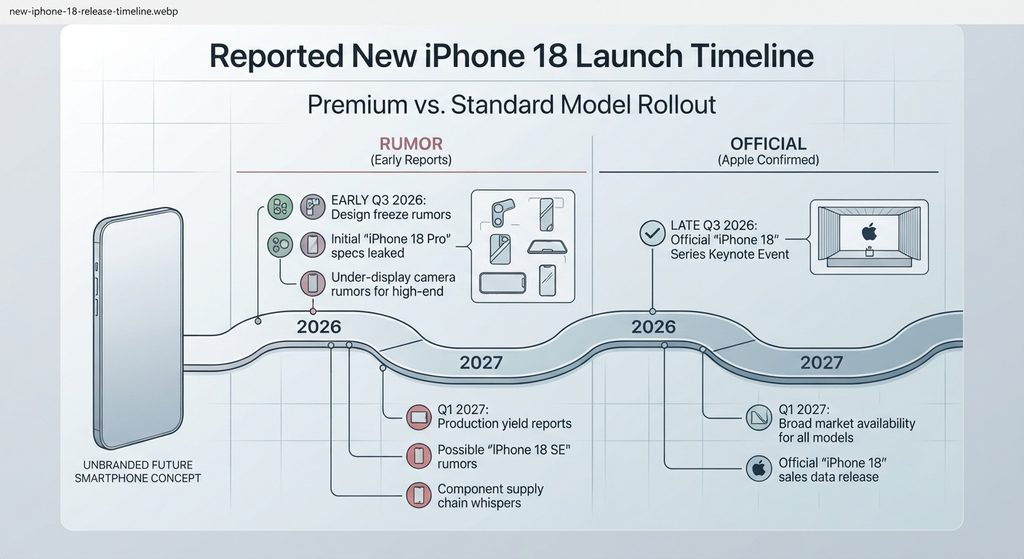
Table of Contents
Table of Contents
New iPhone18: What Is Official Right Now?
As of August 20, 2026, Apple has not announced the iPhone 18, published official specifications, or opened preorders. Apple’s current iPhone page lists the iPhone 17 Pro, iPhone Air, iPhone 17, iPhone 17e, and iPhone 16. Any iPhone18 date, price, design, or specification should therefore be labeled as reported or rumored.
The official baseline is Apple’s current iPhone lineup. Apple confirms that the iPhone 17 uses a 6.3-inch ProMotion display, an A19 chip, a Center Stage front camera, and up to 30 hours of video playback, while the iPhone 17 Pro uses the A19 Pro chip and a more advanced camera system. These current specifications are useful comparison points, not proof of what the next generation will include.
When Is the New iPhone 18 Expected to Launch?
The strongest reporting points to a split release schedule. Reuters, citing a Nikkei Asia report based on four sources, said Apple was prioritizing three premium models in the second half of 2026 while moving the standard iPhone 18 into the first half of 2027. Reuters also stated that it could not independently verify the report and that Apple had not commented. Read the Reuters report.
Current rumor roundups narrow that schedule further: iPhone 18 Pro and Pro Max are expected in fall 2026, while the standard iPhone 18 and iPhone 18e are expected in spring 2027. Apple has not confirmed either window, so exact event, preorder, and shipping dates should not be treated as settled.
| Reported model | Reported launch window | Current confidence | Official Apple confirmation |
|---|---|---|---|
| iPhone 18 Pro | Fall 2026 | Medium to high | No |
| iPhone 18 Pro Max | Fall 2026 | Medium to high | No |
| Foldable iPhone | Second half of 2026 | Medium | No |
| Standard iPhone 18 | First half or spring 2027 | Medium to high | No |
| iPhone 18e | Spring 2027 | Medium | No |
| Possible iPhone Air 2 | Spring 2027 or later | Low to medium | No |
Why a Split iPhone 18 Launch Matters
A split release changes the buying decision. In earlier cycles, a shopper could compare the standard and Pro models at roughly the same time. Under the reported plan, a standard-model buyer may see new Pro phones months before the lower-priced iPhone18 becomes available.
That creates three practical choices: buy an iPhone 17 at a known price, wait for a premium iPhone18 model, or keep your current phone until the standard iPhone18 appears in 2027. Do not assume that every model announced at one event would ship on the same date.
Which iPhone 18 Models Could Be Coming?
The rumored family is broader than a single phone. Reports repeatedly mention a standard iPhone18, iPhone 18e, iPhone 18 Pro, iPhone 18 Pro Max, and a foldable iPhone. A second-generation iPhone Air is also discussed, but its schedule appears less certain.
Standard iPhone 18 and iPhone 18e
The standard iPhone18 should be the mainstream model for buyers who want current performance without Pro-level camera hardware or pricing. Rumors suggest a familiar design and a 6.3-inch display, but that is not an official specification.
The iPhone18e would likely occupy the lower-cost position. Compare its display refresh rate, cameras, storage, charging, connectivity, and Apple Intelligence features rather than assuming the model number guarantees the same experience.
iPhone 18 Pro and iPhone18 Pro Max
The Pro models are the most likely candidates for major 2026 upgrades. Reporting has centered on a next-generation A20 Pro chip, camera changes, a smaller Dynamic Island, and possible internal packaging improvements.
Exact dimensions, weight, storage tiers, colors, and battery ratings for the Pro models remain unconfirmed.
Foldable iPhone and the Possible iPhone Air 2
Reuters reported that Apple was prioritizing its first foldable iPhone as part of the premium 2026 launch plan. A first-generation Apple foldable could attract early adopters, but it would also create unfamiliar questions about durability, repair costs, application behavior, screen creasing, and long-term value.
The possible iPhone Air 2 is less clear. Buyers interested mainly in a thin and light design should wait for official positioning rather than assuming it will launch beside the Pro models.
New iPhone 18 Features: What the Rumors Say
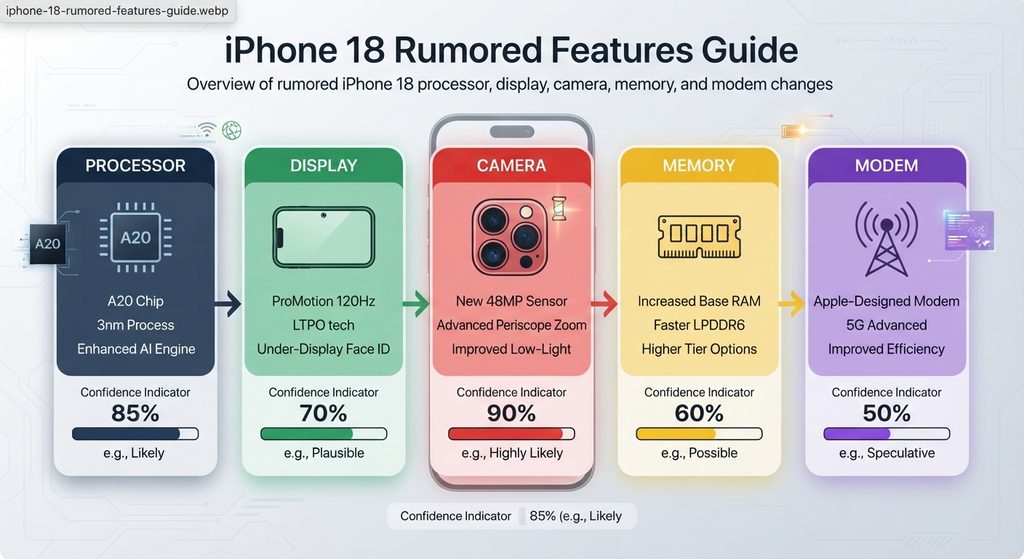
Rumors are most useful when they are ranked by consistency and buyer impact. A processor change mentioned across several reports deserves more attention than a single color leak. The table below separates the major claims by model and confidence.
| Rumored change | Models most often linked to it | Confidence | Why it could matter |
| A20 or A20 Pro chip using a 2nm process | iPhone18 family | Medium to high | Performance, efficiency, heat management |
| Split launch schedule | Entire lineup | Medium to high | Determines how long standard-model buyers wait |
| Smaller Dynamic Island | Pro models; possibly standard 18 | Medium | More usable screen area, visual change |
| Variable-aperture main camera | At least one Pro model | Medium | More control over light and depth of field |
| 9GB or 12GB of RAM | Standard iPhone 18 | Low to medium | Could affect on-device AI features and longevity |
| 24MP front camera | Multiple iPhone 18 models | Low to medium | Higher-resolution front-camera capture |
| Apple-designed C2 modem | Some iPhone 18 models or markets | Medium | Connectivity, efficiency, and platform control |
| Major redesign | Standard iPhone 18 | Low | Current reporting points more toward continuity |
A20 and A20 Pro Chips
The A20 generation is one of the most repeated rumors. MacRumors reports that the iPhone18 and 18e could receive an A20 chip, while the Pro models could use an A20 Pro variant built on a 2-nanometer process. Review the current rumor roundup.
A smaller manufacturing process can improve performance per watt, but the process name alone does not tell you how fast a phone will feel. Apple’s CPU, GPU, Neural Engine, memory, cooling, software, and power targets all affect the final result.
Official specifications and independent testing will be needed to judge sustained performance, battery life, heat, and on-device AI.
Display and Dynamic Island Changes
Rumors describe a smaller Dynamic Island on the Pro models, with some claims extending the change to the standard iPhone 18. That would be a visible refinement, but it is not the same as a completely uninterrupted all-screen design.
Display quality should be evaluated through brightness, refresh rate, outdoor visibility, color accuracy, minimum brightness, efficiency, and durability. A smaller cutout is easy to market, but ProMotion and real battery performance may have a larger effect on everyday use.
The iPhone 17 already has a 6.3-inch ProMotion display, according to Apple’s iPhone 17 overview. A standard iPhone 18 buyer should therefore look for measurable improvements rather than assuming a new number automatically delivers a major display upgrade.
Camera Upgrades
The most substantial camera rumor concerns a variable aperture on at least one iPhone 18 Pro model. A variable aperture changes how much light enters the lens and can give photographers more control over exposure and depth of field. The real benefit will depend on the aperture range, sensor, processing, and how much manual control Apple provides.
MacRumors has also reported a possible 24-megapixel front camera across the lineup, up from the 18-megapixel front camera used on current iPhone 17 models. Treat that figure as unconfirmed until Apple publishes a specification page.
RAM and Apple Intelligence
The RAM reports conflict. One source path points to 9GB for the standard iPhone 18, while another points to 12GB. That disagreement is a warning not to repeat either number as fact.
Memory could matter because more Apple Intelligence work is performed on the device. Apple’s current support page says Apple Intelligence requires an iPhone 15 Pro model or an iPhone 16 model or later. See Apple’s current device requirements.
Apple has also previewed new Siri AI and Apple Intelligence features for iOS 27. The iPhone 18 will be judged not only by whether it supports those features, but by which functions are available on each model, language, and region. Buyers should verify feature availability at launch instead of relying on a general “AI phone” label.
Modem, 5G and Connectivity
Some reports expect an Apple-designed C2 modem in parts of the iPhone 18 lineup. The U.S. version could differ from models sold elsewhere, and Apple may use different modem suppliers by market.
This matters more than the modem name suggests. Network compatibility, mmWave support, power use, roaming, and carrier certification can affect the actual experience. Wait for Apple’s technical specifications and carrier documentation before importing a phone or assuming every regional model is identical.
Current U.S. iPhone 17-family devices sold by Apple use eSIM rather than a physical SIM tray. Apple notes that eSIM requires carrier support and that carrier-financed phones can remain locked until they are paid off. Review Apple’s current U.S. buying guidance.
Design, Battery and Storage
Battery capacity is only one part of endurance; the chip, modem, display, software, temperature, and usage all matter. The iPhone 18 storage tiers are also unknown, so compare official configurations and prices when the product page appears.
How Much Will the New iPhone 18 Cost?
There is no official iPhone 18 price. Any exact dollar amount published before Apple’s announcement is an estimate, leak, or unsupported claim. The safest planning method is to use current U.S. iPhone prices as reference points and keep room in the budget for tax, AppleCare, accessories, storage upgrades, and carrier terms.
Apple currently lists the iPhone 17e from $599, the iPhone 17 from $799, and the iPhone 17 Pro from $1,099 in the United States. Those numbers establish the existing tiers, but they do not guarantee iPhone 18 pricing. Compare current models and prices on Apple.
| Current official model | Current U.S. starting price | What it helps estimate |
| iPhone 17e | $599 | Entry-level benchmark |
| iPhone 17 | $799 | Mainstream benchmark |
| iPhone 17 Pro | $1,099 | Premium benchmark |
| iPhone 18 models | Not announced | No verified price yet |
Do not send a deposit to an unknown seller claiming to secure an iPhone 18 before Apple or an established authorized retailer opens orders. A credible preorder should identify the exact model, storage, total price, delivery estimate, cancellation terms, carrier status, warranty coverage, and return policy.
New iPhone 18 vs iPhone 17
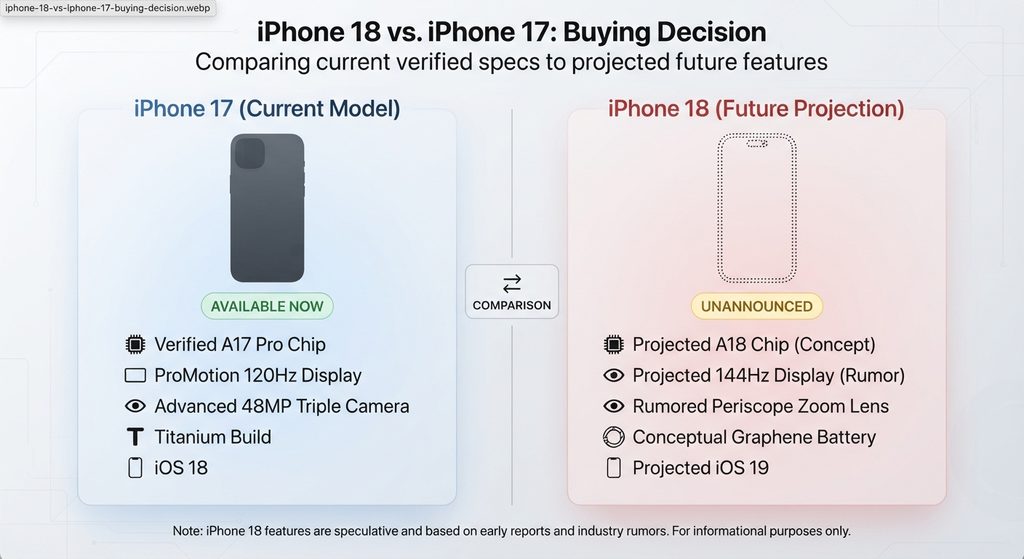
The iPhone 17 is a real product with verified specifications and pricing. The iPhone 18 is an unannounced family described through reporting and rumors. That makes a conventional specification comparison impossible today.
| Decision factor | iPhone 17 today | New iPhone 18 expectation |
| Availability | Available | Pro models reported for fall 2026; standard model reported for 2027 |
| Processor | A19 | A20 generation rumored |
| Display | 6.3-inch ProMotion on iPhone 17 | Similar size rumored; exact improvements unknown |
| Front camera | 18MP Center Stage | 24MP rumored |
| Price | From $799 for iPhone 17 | Not announced |
| Reviews | Real-world tests available | No retail hardware to test |
| Purchase risk | Normal retail decision | High risk if buying from an unofficial “preorder” seller |
The iPhone 17 already delivers ProMotion, an A19 chip, two rear cameras, Apple Intelligence support, and up to 30 hours of video playback according to Apple. It is the rational choice for someone who needs a phone now and values certainty.
Waiting becomes more rational when your current device is reliable and the rumored A20 generation, camera changes, or new form factors directly address something you care about. Waiting only because “the next model will be better” can become an endless cycle.
Should You Wait for the iPhone 18 or Buy Now?
Use your current phone’s condition and the expected model tier as the main decision variables. Do not base the decision on one unverified specification.
Who Should Wait
Wait for more iPhone 18 information if:
- Your current phone works reliably and still receives security updates.
- You specifically want an iPhone 18 Pro or Pro Max and can wait for Apple’s next announcement.
- Camera control, on-device AI, or battery efficiency matters enough to justify delaying a purchase.
- You want to compare a possible foldable iPhone with established foldable devices.
- You prefer buying after independent reviews identify heat, battery, camera, or durability issues.
- You are targeting the standard iPhone 18 and can potentially wait into 2027.
Who Should Buy a Current iPhone
Buy a current model if:
- Your present phone is broken, unreliable, unsafe to use, or no longer meets essential needs.
- You need a phone for school, work, travel, authentication, or family communication now.
- The iPhone 17 already provides the display, camera, storage, and performance you need.
- A verified trade-in or carrier offer creates a lower total cost than waiting.
- You value established reviews and known accessories over first-day hardware.
The best value is not always the newest phone. A current model purchased at a transparent price can be a better decision than a future model with uncertain availability and cost.
Which iPhone 18 Model Could Fit You Best?
Choose a tier before chasing individual rumors. That prevents premium features from pulling you into a higher price class that does not match your real use.
- Standard iPhone 18: Mainstream buyers seeking a balance of price, performance, and cameras.
- iPhone 18e: Budget-focused buyers willing to accept verified compromises.
- iPhone 18 Pro: Creators, frequent camera users, and demanding games.
- iPhone 18 Pro Max: Buyers prioritizing the largest display and battery endurance.
- Foldable iPhone: Early adopters willing to accept first-generation price and durability uncertainty.
Do not select the Pro model merely because it is labeled “Pro.” If you mainly use messaging, navigation, photos, browsing, video, and everyday apps, the standard model may deliver the better cost-to-use ratio.
Pros and Cons of Waiting for the New iPhone 18
| Pros of waiting | Cons of waiting |
| You can evaluate the A20 generation and new camera features | The standard model may not arrive until 2027 |
| Current iPhone prices or trade-in offers may change after a launch | Rumored features may be delayed, changed, or limited to Pro models |
| Independent reviews can reveal real battery and camera performance | Your current phone continues to lose trade-in value |
| More model choices may become available | Premium models may cost more than your budget allows |
| You avoid buying immediately before a major announcement | Waiting has little value if your current device is failing |
Waiting is valuable only when it preserves options without creating a practical problem. If a failing battery or unreliable phone disrupts essential use, a known current model is usually the stronger decision.
U.S. Buyer Checklist Before Ordering
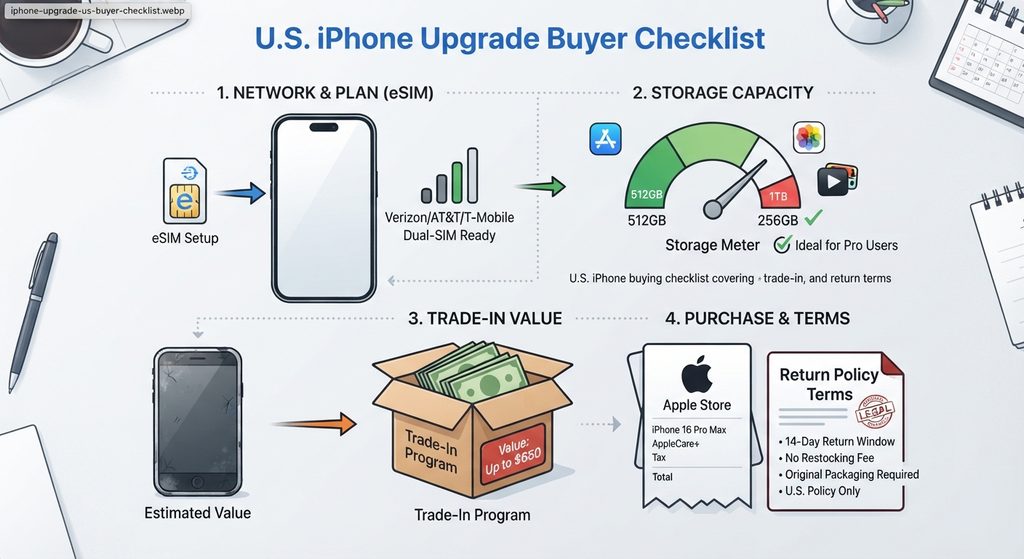
- Confirm the product exists on Apple.com. A real Apple announcement should include a product page, specifications, price, and availability details.
- Choose the model tier before storage. Decide between standard, e, Pro, Pro Max, or foldable based on use, then price the needed storage.
- Calculate the total cost. Include sales tax, AppleCare, a case, charging accessories, financing costs, and the effect of any carrier commitment.
- Verify carrier status. Check 5G bands, eSIM support, activation requirements, roaming, and whether financing locks the phone.
- Check storage on your current device. Apple recommends confirming that your data will fit on the new phone before transfer. See Apple’s storage guidance.
- Read the return policy. Apple’s current U.S. retail policy generally provides 14 calendar days for eligible returns or exchanges, subject to its conditions. Review the current U.S. policy.
- Protect your trade-in data. Back up and transfer your information before erasing the old phone. Do not remove your only working copy first.
- Compare final prices, not promotional headlines. Carrier credits may be spread across many bills and can require an eligible plan or trade-in.
Common iPhone 18 Buying Mistakes
Treating Every Leak as a Confirmed Specification
Supply-chain information, prototypes, analyst notes, and social media posts do not have equal reliability. Even accurate early information can change before production.
Label each claim. Use “Apple confirms” only for an Apple source, “reported” for sourced reporting, and “rumored” for unverified details.
Believing an Exact Price Before the Announcement
No seller can convert an unconfirmed price into an official one. Build a budget range from current models, then wait for Apple and major carriers to publish full terms.
Ignoring eSIM and Carrier Locks
Current U.S. iPhones sold by Apple are eSIM-only, and some carrier financing arrangements lock the device until it is paid in full. An imported phone or a carrier deal may have different rules.
Upgrading for a Feature You Will Not Use
A variable-aperture camera can matter to a serious mobile photographer but provide little value to someone who mainly takes casual daylight photos. Tie every premium feature to a real task.
Preordering Before Reading the Conditions
Availability pressure can hide financing terms, trade-in deadlines, restocking rules, or activation requirements. Save the order confirmation and take time to review the total commitment.
How to Prepare for an iPhone Upgrade
You can prepare without deciding on a model. Good preparation reduces transfer problems and makes the final price easier to evaluate.
- Update your current phone and apps. This reduces compatibility problems during migration.
- Create a fresh backup. Use iCloud or a computer and confirm the backup completed.
- Review storage use. Remove unwanted downloads only after confirming important data exists elsewhere.
- Check account access. Make sure you know your Apple Account password and can receive two-factor authentication codes.
- Confirm carrier support. Ask whether your number supports eSIM Quick Transfer and whether any device balance must be paid first.
- Record your trade-in condition. Photograph the device and note any damage before shipping it.
- Transfer before erasing. Apple’s Quick Start instructions explain how to place the new device near the current one and follow the onscreen process.
- Activate cellular service. Apple’s eSIM setup guide covers transferring a plan from a nearby iPhone or adding an eSIM.
- Verify critical data. Check contacts, photos, messages, authenticator apps, banking access, files, and health data on the new phone.
- Erase the old device only after verification. Apple’s trade-in preparation guidance starts with backing up and transferring information before personal data is removed.
Keep the old phone charged and available until calls, messages, authentication, and important apps work on the new device. A fast setup is less important than a verified transfer.
Final Verdict
The new iPhone 18 is worth watching, but it is not yet a product that U.S. buyers can evaluate through official specifications, prices, or independent reviews. The most credible current reporting suggests premium models in the second half of 2026 and the standard iPhone 18 in the first half of 2027.
Wait if your current phone is reliable and the A20 generation, Pro camera changes, or a foldable design directly matters to you. Buy a current iPhone if you need dependable hardware now and the verified iPhone 17 features meet your needs. The logical next step is to monitor Apple’s official iPhone page and make the final comparison only after Apple publishes model-specific details.
FAQ
Is the new iPhone 18 officially announced?
No. As of August 20, 2026, Apple’s official iPhone lineup does not include an iPhone 18. Specifications, prices, preorder dates, and availability claims remain unconfirmed until Apple publishes them.
When will the iPhone 18 be released?
Reporting suggests iPhone 18 Pro models could arrive in the second half of 2026, while the standard iPhone 18 may move to the first half of 2027. Apple has not confirmed that schedule.
Will there be an iPhone 18 Pro and Pro Max?
Multiple reports describe iPhone 18 Pro and Pro Max models as part of the premium 2026 lineup. Final names, specifications, and availability still require official confirmation.
How much will the iPhone 18 cost in the United States?
Apple has not announced an iPhone 18 price. Current U.S. starting prices—$599 for iPhone 17e, $799 for iPhone 17, and $1,099 for iPhone 17 Pro—are useful benchmarks, not forecasts.
What are the biggest rumored iPhone 18 upgrades?
The most repeated rumors include an A20 chip generation, possible 2nm manufacturing, a smaller Dynamic Island, camera changes on Pro models, and an Apple-designed modem in some devices or markets. None is an official final specification.
Will the iPhone 18 have under-display Face ID?
Reports about display changes conflict, and current rumors more consistently describe a smaller Dynamic Island than a completely hidden Face ID system. Wait for Apple’s product images and technical specifications.
Will the iPhone 18 support Apple Intelligence?
Apple has not published iPhone 18 compatibility details. Current Apple Intelligence requirements include iPhone 15 Pro models and iPhone 16 models or later, making next-generation support likely, but model-specific features may depend on hardware, language, and region.
Should I buy the iPhone 17 or wait for the iPhone 18?
Buy the iPhone 17 if you need a phone now and its verified features meet your needs. Wait if your current phone works well and you specifically want to compare the reported A20 generation, Pro camera changes, or a new form factor.
Can I preorder the iPhone 18 now?
There is no official Apple iPhone 18 preorder at the time of this update. Avoid sending money to unknown sellers offering guaranteed units or early reservation access.
Will a U.S. iPhone 18 use eSIM only?
Apple has not confirmed the iPhone 18 SIM configuration. Current iPhone 17-family models purchased in the United States or Puerto Rico are eSIM-only, so U.S. buyers should verify carrier support when official iPhone 18 specifications appear.